
BlogAug 18, 2026Retail Stores
The Retail Scheduling Maturity Model: Five Stages From Rota to Demand
Five stages from a fixed weekly rota to demand-led labor allocation, what each stage costs, and the single next step that moves you up one level.
Insights and deep dives from the Ariadne team and the venues we work with.
Two questions, twenty minutes, a real walkthrough of your venue's footfall.
What to expect
Got a different question?
Anything that isn't a sales conversation. We'll route it to the right person and get back within one business day.
BlogAug 18, 2026Retail Stores
Five stages from a fixed weekly rota to demand-led labor allocation, what each stage costs, and the single next step that moves you up one level.

BlogAug 18, 2026Retail Stores
Most retail scheduling tools differ less in features than in what they plan against. The axis that matters, plus the six checks that survive a demo.

BlogAug 18, 2026Retail Stores
Sales are down and the argument starts. A decision tree that separates falling visits from falling conversion, and names the fix for each branch.

BlogAug 18, 2026Retail Stores
Seven levers that move in-store conversion, each with the measurement that proves it: staffing, entrance, dead zones, queues, fitting rooms, dwell, and hours.

BlogAug 18, 2026Retail Stores
Published retail conversion benchmarks compare incompatible numbers. Why they mislead, how rates differ by category, and how to build a baseline that works.

BlogAug 17, 2026Retail Stores
The claim that privacy-friendly counting must be less accurate confuses identification with measurement. What identity actually buys, and what it does not.

BlogAug 17, 2026Retail Stores
Uncounted staff movements silently inflate footfall and wreck conversion rates. How staff exclusion works, what it costs to ignore, and how to verify it.

BlogAug 17, 2026Retail Stores
Accuracy is a budget, not a virtue. Four use-case tiers with the accuracy each genuinely requires, from footfall trends to occupancy compliance.

BlogAug 17, 2026Retail Stores
Sign-off is the last moment the balance of power favors you. A written acceptance test for counting systems: coverage, accuracy, integration, failure procedure.

BlogAug 17, 2026Retail Stores
Counting systems fail quietly. The service terms that matter: detection of silent failure, response times, calibration cadence, firmware, and end of term.

BlogAug 17, 2026Retail Stores
Finance does not buy visibility, it buys returns. The four value lines that survive scrutiny, the numbers to gather first, and the one-page memo structure.

BlogAug 17, 2026Retail Stores
Counts that stay in a vendor dashboard change nothing. The integration requirements to specify: APIs, exports, BI, workforce systems, and identity.

BlogAug 17, 2026Retail Stores
Most pilots end in a shrug. How to design a counting trial with a decision rule, an accuracy test, and success criteria agreed before the sensors arrive.

BlogAug 17, 2026Retail Stores
Who owns the counts, where they are processed, what the sensor may capture, what happens at termination: the clauses that decide a counting contract.

BlogAug 17, 2026Retail Stores
Weighted criteria beat gut feel and demo polish. A scorecard for counting vendors across accuracy, privacy, integration, service, and five-year cost.

BlogAug 17, 2026Retail Stores
RFPs demand "at least 95% accuracy" without defining it. What the number can mean, how to write a spec that is testable, and the traps in each formulation.

BlogAug 17, 2026Smart Cities
European tenders treat privacy as a technical requirement, not a promise. How counting requirements are structured, and the answers that survive evaluation.

BlogAug 17, 2026Smart Cities
Libraries, transit, city halls, campuses: how public bodies buy people counting, what the compliance layer adds, and how to write a spec that gets real bids.

BlogAug 17, 2026Shopping Malls
Single-floor routing is geometry; multi-floor routing is choices: lifts vs escalators vs stairs, accessibility, transitions. Why the vertical dimension breaks

BlogAug 17, 2026Shopping Malls
Signage gets approved in a meeting room and fails in a corridor. The behavioral metrics that show whether wayfinding signs actually work, and how to test them.

BlogAug 17, 2026Shopping Malls
Kiosks get placed where the architect left room, then ignored. Placing them where journeys measurably hesitate, and verifying usage afterwards.

BlogAug 17, 2026Shopping Malls
A static map costs little and lies within months; a kiosk costs more and stays true. The honest cost and effectiveness comparison, and when each is right.

BlogAug 17, 2026
Routing is a solved library problem; maps, positioning, and updates are not. The real cost structure of building indoor navigation against buying a platform.

BlogAug 17, 2026
Beacon fleets die of maintenance. What infrastructure-free indoor navigation means, how it works, and the honest trade-offs against beacon and UWB deployments.

BlogAug 17, 2026Shopping Malls
Wayfinding projects start at the front door; visitors start in the parking structure. Closing the parking gap, and why "where is my car" is the killer feature.

BlogAug 17, 2026Airports
Every airport journey has a deadline. How terminal navigation handles security, gate changes, and connections, and what Glasgow's deployment shows.

BlogAug 17, 2026Shopping Malls
Nobody downloads an app to find a shoe store. What mall navigation actually gets used: web routes, kiosk handoffs, parking memory, and deal-led wayfinding.

BlogAug 17, 2026
Hot desks, bookable rooms, and colleagues in twice a week: why office wayfinding became a real problem, and what fixes it without badge-tracking employees.

BlogAug 17, 2026
Campuses are cities with semesters: open days, first weeks, exam rooms, visiting families. What campus navigation must handle that a city map app cannot.

BlogAug 17, 2026
Missed appointments, stressed visitors, staff interruptions: what hospital indoor navigation actually fixes, the buyer's checklist, and the infrastructure trap.

BlogAug 17, 2026Retail Stores
A working agenda for a retail journey mapping workshop: who attends, the five exercises, the data to bring, and how the map becomes a testable backlog.

BlogAug 17, 2026Retail Stores
The journey does not end at the till: click-and-collect, returns, and service visits bring buyers back into the store. How to measure and monetize those visits.

BlogAug 17, 2026Retail Stores
Kiosks, configurators, demos, fitting tech: where interactivity genuinely lifts conversion in store, where it is theater, and how to measure the difference.

BlogAug 17, 2026Retail Stores
Every journey claim rests on touchpoint measurement: entries, zones, dwell, paths. How the measurement layer works camera-free, and what it can and cannot see.

BlogAug 17, 2026Retail Stores
Capture, reach, dwell, engagement, conversion, repeat: the six KPI families that describe a physical customer journey, and the traps in each one.

BlogAug 17, 2026Retail Stores
Browse, consider, convert happens in both worlds; the measurement differs. Mapping e-commerce metrics to their store-floor equivalents, stage by stage.

BlogAug 17, 2026Retail Stores
Digital and in-store journeys meet at measurable seams: click-and-collect, returns, store visits after campaigns. How to unify the picture without identity

BlogAug 17, 2026Retail Stores
Electronics shoppers arrive pre-researched and leave decided by staff contact. The journey stage by stage, and the coverage math that wins or loses it.

BlogAug 17, 2026Retail Stores
Furniture journeys are long, comparative, and often end without a purchase by design. How showrooms read multi-visit journeys and set up the second visit.

BlogAug 17, 2026Retail Stores
Mall journeys mix missions: anchors, corridors, food courts, and dwell. How operators read visitor journeys across tenants and turn them into leasing evidence.

BlogAug 17, 2026Retail Stores
Grocery journeys are missions, not strolls: route habits, dwell islands, and queue endings. How the fastest journey in retail is measured and improved.

BlogAug 17, 2026Retail Stores
From window to fitting room to till: the fashion retail journey stage by stage, where it leaks shoppers, and how each stage is measured on a real floor.

BlogAug 17, 2026Digital Signage
Programmatic DOOH runs on venue data. How footfall feeds reach DSPs and SSPs: audience packs, triggers, reporting feeds, and the privacy line that must hold.

BlogAug 17, 2026Digital Signage
Airport ad inventory is priced on audience, and the audience is measurable: passenger flow, dwell by zone, and the difference between traffic and attention.

BlogAug 17, 2026Digital Signage
Brands are starting to audit in-store retail media the way they audit digital. How venues verify audience claims with camera-free measurement that survives

BlogAug 17, 2026Digital Signage
Screen placement is a testable variable, not a hunch. How to A/B test signage positions with footfall and dwell data, and the mistakes that invalidate the test.

BlogAug 17, 2026Digital Signage
Impressions count opportunity; attention metrics estimate notice. What attention measurement can and cannot do in DOOH, and the dwell data that grounds it.

BlogAug 17, 2026Digital Signage
Retail media is moving onto the shop floor, and the measurement has to follow. Audience, exposure, and lift for in-store screens, decoded for retailers and

BlogAug 17, 2026Digital Signage
Impressions, reach, frequency, viewability, attribution: what each metric means in out-of-home versus online, and where the definitions quietly diverge.

BlogAug 17, 2026Digital Signage
Loop length, share of voice, play logs, impression multipliers: the DOOH spec sheet decoded for buyers and creatives, and which lines actually move outcomes.

BlogAug 15, 2026Retail Stores
Every counting sensor sees part of the picture. How fusion architectures combine streams, why central fusion beats edge stitching, and how Hybrid Fusion works.

BlogAug 15, 2026Retail Stores
Two data structures for the same reality: what a depth map is, what a point cloud is, how sensors convert between them, and why neither is a photograph.

BlogAug 15, 2026Retail Stores
Sunlight is an infrared floodlight aimed at your sensor. The physics of ambient light noise, and the engineering that keeps outdoor ToF deployments honest.

BlogAug 15, 2026Retail Stores
Where ToF sensing earns its keep: autofocus, robotics, dimensioning, industrial safety, occupancy, and people counting. One principle, a dozen industries.

BlogAug 15, 2026Retail Stores
From commodity ranging modules to counting systems: the components, certifications, and hidden system costs that decide what a ToF deployment really costs.

BlogAug 15, 2026Retail Stores
Two ways to time light: dToF clocks each pulse, iToF reads phase shift. How the designs differ in range, sunlight, resolution, and what buyers should ask.

BlogAug 15, 2026Retail Stores
Both time a round trip; one uses light, one uses sound. Why the physics gap decides resolution, speed, and which jobs each ranging technology should own.

BlogAug 15, 2026Retail Stores
PIR counters are cheap and battery-friendly; ToF counters resolve individuals and groups. Where each genuinely wins, from low-traffic doors to busy entrances.

BlogAug 15, 2026Retail Stores
How ToF people counters work, why they beat cameras on privacy and low light, and the six things to check before you buy one, from mount height to data path.

BlogAug 15, 2026Retail Stores
What a ToF datasheet's accuracy and range figures actually mean, the five factors that move them on site, and how to verify a claim before you rely on it.

BlogAug 15, 2026Retail Stores
How a ToF camera turns light travel time into a depth image, what separates it from a single-zone ToF sensor, and where depth cameras earn their place.

BlogAug 15, 2026Retail Stores
ToF is a measuring principle; LiDAR is a sensing system built on it. Where each fits, what they cost in practice, and which one people counting actually needs.

BlogJul 2, 2026Transportation Hubs
How automatic passenger counting (APC) works on buses, trains, and at airports. The sensor methods compared, the accuracy to expect, and how to choose a system.

BlogJul 2, 2026Transportation Hubs
Passenger flow management moves people through airports and stations without bottlenecks. The metrics that run a hub, where flow breaks down, and how to

BlogJul 2, 2026Events & Exhibitions
Visitor flow is how people move through a museum, gallery, or attraction. Measure circulation and dwell camera-free, and manage capacity, bottlenecks, and

BlogJul 2, 2026Retail Stores
Customer flow is how people move through any space where they are served. What it means, how to measure it camera-free, and how to manage queues and staffing

BlogJul 2, 2026Digital Signage
Schedule store screen content to real traffic: read the hourly footfall shape, daypart your best promotions to peak and high-dwell windows, then re-time.

BlogJul 2, 2026Digital Signage
DOOH audience measurement sizes who was actually in front of a screen: passers, in-zone viewers, dwell. Camera-free, no PII, presence not profiling.

BlogJul 2, 2026Digital Signage
Measure in-store screen ROI: pair screen cost with dwell, zone traffic, and conversion. Capture dwell camera-free with no PII, then build a payback model.

BlogJul 2, 2026Digital Signage
Retail media footfall attribution proves in-store screens moved people. Measure passers, dwell, zone traffic camera-free, no PII, for a defensible report.

BlogJul 2, 2026Retail Stores
The ROI of footfall-based scheduling: trim over-staffed troughs, recover peak conversion. Build a before/after case on real counts, with a sample model.

BlogJul 2, 2026Retail Stores
The labor-to-traffic ratio is visitors per staff hour. How to calculate it from counted footfall, set a target per daypart, and schedule to it.

BlogJul 2, 2026Retail Stores
Footfall-based staff scheduling builds the roster from measured store traffic, not last year's sales. Forecast demand, turn counts into hours, staff to it.

BlogJul 2, 2026Airports
Plan airport terminal capacity from footfall data: level of service, the design peak, modelled versus measured flow, and finding the bottleneck processor.

BlogJul 2, 2026Airports
How airports manage baggage reclaim flow: why arrivals are bursty, matching belt allocation and staffing to the arrival bank, and the handoff to curbside.

BlogJul 2, 2026Airports
Airport retail conversion explained: capture rate, conversion, and the dwell window between security and boarding that sets the ceiling on both.

BlogJul 2, 2026Airports
How airports manage lounge occupancy: live capacity against a comfort threshold, why lounges crowd on flight banks, and the decisions the data drives.

BlogJul 2, 2026Airports
How airports predict security checkpoint wait: upstream flow as the leading indicator, staffing lanes to a service level, and why queue is not wait time.

BlogJul 2, 2026Smart Cities
Measure turnout and movement at festivals and city events: multi-entrance counts, arrival curves, dwell across the site, and camera-free outdoor sensing after

BlogJul 2, 2026Smart Cities
How to measure footfall in stations and interchanges: directional flow, peak surges, concession siting, and camera-free counting on a busy public concourse.

BlogJul 2, 2026Smart Cities
How to measure occupancy and dwell in plazas and parks: line-crossing vs area counts, camera-free outdoor sensing, and using it for design and maintenance.

BlogJul 2, 2026Smart Cities
Measure town-centre recovery the right way: set a baseline, track a recovery index, read dwell and repeat visits, and attribute the rebound to interventions.

BlogJul 2, 2026Smart Cities
How to design a city bike-count program: permanent vs temporary counters, siting, factoring short counts to annual totals, and the active-travel case.

BlogJul 2, 2026Smart Cities
Every way to count pedestrians compared: manual, thermal, computer vision, signal, and camera-free Time-of-Flight. Accuracy, privacy, night, cost for cities.

BlogJul 2, 2026Shopping Malls
Indoor map data standards explained: IMDF and its GeoJSON base, IndoorGML for routing, and how CAD and BIM sources convert into a consistent indoor map.

BlogJul 2, 2026Shopping Malls
How to design accessible, step-free wayfinding routes indoors: elevators over stairs, grade and door limits, ADA principles, and mapping accessible route data.

BlogJul 2, 2026Shopping Malls
How to design a wayfinding kiosk: hardware and screen choices, map UX, placement at decision points, accessibility, and when to choose kiosk or mobile.

BlogJul 2, 2026Shopping Malls
How a visual positioning system locates users indoors from the phone camera, why it powers AR wayfinding, its lighting limits, and the camera-free alternative.

BlogJul 2, 2026Shopping Malls
BLE beacons vs UWB compared: how each locates a device, the accuracy gap, infrastructure and battery cost, and a clear decision framework for indoor

BlogJul 2, 2026Shopping Malls
How UWB indoor positioning works: time-of-flight ranging, anchors and tags, decimetre accuracy, cost, and where ultra-wideband fits against other methods.

BlogJul 2, 2026Shopping Malls
3D indoor mapping explained: how a dimensional interior model differs from a 2D floor plan and a digital twin, and why it needs a positioning layer to navigate.

BlogJul 2, 2026Retail Stores
When does a Betriebsrat have co-determination over footfall counters under the BetrVG, and why camera-free counting that measures customers lowers the concern.

BlogJul 2, 2026Retail Stores
Counting a crowd is not watching a person. How people counting differs from surveillance in purpose and method, and how to explain it to a works council.

BlogJul 2, 2026Retail Stores
GDPR data minimisation means collecting only what the purpose needs. Footfall needs counts, dwell, and paths, not identity. How camera-free counting does it.

BlogJul 2, 2026Retail Stores
Privacy by design under GDPR Article 25 means collecting no personal data at all. How a camera-free counting sensor builds that in, not bolts it on.

BlogJul 2, 2026Retail Stores
Camera-free people counting sits outside the EU AI Act Annex III high-risk biometric category. Why, the Annex III test, and what to confirm with your DPO.

BlogJul 2, 2026Retail Stores
What does Schrems II mean for retail analytics? How the CJEU transfer ruling affects footfall data, residency vs transfer, and why no-PII counting changes it.

BlogJul 2, 2026Retail Stores
How do you count people without a camera? The physics of depth and signal sensing, what each captures, and why no-camera counting records shapes, never faces.

BlogJul 2, 2026Retail Stores
Do you need consent to count footfall? Why a no-PII method needs no consent banner, where consent still applies, and how camera-free counting stays clear.

BlogJul 2, 2026Retail Stores
Anonymous people counting measures footfall and flow with no identity captured. What anonymous means, how it differs from anonymized, which methods qualify.

BlogJul 2, 2026Retail Stores
Is people counting GDPR compliant? When footfall counts as personal data under GDPR, which methods avoid it, and how camera-free counting stays out of scope.

BlogJul 2, 2026Retail Stores
Time spent per zone shows where inside a visit the time actually goes. How zone dwell differs from store dwell, what it diagnoses, and how to measure it

BlogJul 2, 2026Retail Stores
Visit frequency analysis measures how often shoppers come back, not just the total. The metrics, what they reveal, and how to spot a return without IDing

BlogJul 2, 2026Retail Stores
The busiest hour is rarely the best-converting hour. How to build an hourly conversion curve, what its shape means, and how to staff to it, not just to traffic.

BlogJul 2, 2026Shopping Malls
Cross-shopping shows which mall tenants share shoppers. What it reveals for leasing and cross-promotion, and how to measure it without cameras.

BlogJul 2, 2026Retail Stores
Window conversion rate is the share of passers-by who walk in. The formula, how it differs from capture and conversion rate, and how to count the traffic it

BlogJul 2, 2026Retail Stores
Footfall and basket size move on different levers. How the two relate, the four traffic-and-basket patterns, and how to measure the entry count basket analysis

BlogJul 2, 2026Retail Stores
Grade stores by footfall the fair way: normalise for size and catchment, read conversion and sales per visitor, and sort your estate into A, B, and C tiers.

BlogJul 2, 2026Retail Stores
Shopper density is people per square metre. How to measure it from live occupancy, where comfort and safety thresholds sit, and how to control flow.

BlogJul 2, 2026Retail Stores
Queue length analytics measures who is waiting, for how long, and who gives up. The core metrics, where to place a zone, and how to trigger staffing in real

BlogJul 2, 2026Retail Stores
Store bounce rate maps the web metric to retail: visitors who enter and leave fast. How to define it, why it differs from conversion, and what fixes a high

BlogJul 2, 2026Retail Stores
Repeat visit rate is the share of visits from returning shoppers. The formula, the new-vs-returning split, and how to measure loyalty without collecting

BlogJul 2, 2026Retail Stores
Dwell time vs footfall: footfall counts arrivals, dwell measures time inside. How they interact, the four quadrants, and when to prioritise each metric.

BlogJul 1, 2026Retail Stores
Free vs paid people counters: what a free clicker or app can do, where it breaks, and when a verified paid system is worth the cost for real decisions.

BlogJul 1, 2026Retail Stores
People counting total cost of ownership over five years: hardware, install, software, support and recalibration, plus what drives the price.

BlogJul 1, 2026Retail Stores
Beam, camera, thermal, Time-of-Flight and fusion compared: what each method records, how each behaves on groups and crowds, the law that follows, and cost.

BlogJul 1, 2026Retail Stores
A people counting buyer's guide: define the question, match the sensor, decide what you capture, verify accuracy and cost, then pilot before you sign.

BlogJul 1, 2026Retail Stores
A buyer-side Countwise alternative comparison on accuracy, capture, interior journeys, and 5-year cost, plus how Ariadne's depth-and-fusion method differs.

BlogJul 1, 2026Retail Stores
A Brickstream alternative comparison on accuracy, capture, support, and 5-year cost, with how Ariadne's camera-free counting differs on its own terms.

BlogJul 1, 2026Retail Stores
An Axis people counter alternative: camera-based counting vs Ariadne's camera-free method, what changes for CCTV and DPIA, and how to trial both fairly.

BlogJul 1, 2026Retail Stores
A camera-free alternative to Hikvision people counting: how Ariadne counts without images, what changes for CCTV and DPIA, and how to run a like-for-like trial.

BlogJul 1, 2026Retail Stores
A buyer-side Irisys alternative comparison on accuracy, capture, install, and 5-year cost, plus how Ariadne's camera-free counting differs on its own terms.

BlogJul 1, 2026Retail Stores
Weighing a DILAX alternative on accuracy, what the system records, install, and 5-year cost, with how Ariadne's camera-free counting differs on its own terms.

BlogJul 1, 2026Retail Stores
Comparing a ShopperTrak alternative on accuracy, what it captures, install, and 5-year cost. How Ariadne's camera-free counting differs, on its own terms.

BlogJul 1, 2026Shopping Malls
How to prove a mall redevelopment lifted footfall: baseline, control, seasonality, sustained vs reopening-spike visits, and the mistakes that inflate success.

BlogJul 1, 2026Shopping Malls
Shopping center types compared: neighborhood, community, regional, superregional, and power centers by size, anchor, trade area, and footfall profile.

BlogJul 1, 2026Shopping Malls
Percentage rent, the breakpoint, and the formula explained, plus why center footfall is the leading indicator of the overage rent a landlord earns.

BlogJul 1, 2026Shopping Malls
A grocery-anchored center draws frequent, necessity-led visits, making footfall defensive in a downturn. How it differs from a mall and what the data proves.

BlogJul 1, 2026Shopping Malls
Anchor vs inline tenant compared: space, rent per square foot, lease term, who depends on whose traffic, and what inline stores prove with a door count.

BlogJul 1, 2026Shopping Malls
A shadow anchor drives traffic to a center it isn't leased to. What it is, how it differs from an on-site anchor, the upside, and the co-tenancy risk.

BlogJul 1, 2026Shopping Malls
A junior anchor is a mid-size traffic draw smaller than a department store. Which categories qualify, typical size, lease economics, and why they are gaining.

BlogJul 1, 2026Shopping Malls
Anchor tenant examples by format: department stores, supermarkets, big-box, plus the cinema and food-hall anchors replacing them, and how to prove they pull.

BlogJun 30, 2026Retail Stores
Hardware store people counting separates trade-morning and DIY-afternoon traffic, covers every entrance, and measures conversion across a big-box floor.

BlogJun 30, 2026Retail Stores
Bookstore footfall counting turns browsers into a conversion number, shows dwell by section, and measures whether events and windows pulled people in.

BlogJun 30, 2026Retail Stores
Salon and spa footfall counting captures walk-ins, retail-only visits, and no-shows the diary misses, with counting at reception and never the treatment areas.

BlogJun 30, 2026Events & Exhibitions
Theme park attendance analytics map flow between zones, queue build, and dwell across the day, so operations redeploy staff and time shows to relieve crowding.

BlogJun 30, 2026Retail Stores
Cinema foot-traffic counting captures arrival surges and concession dwell around showtimes, so the bar is staffed to the real rush, not the screening clock.

BlogJun 30, 2026Retail Stores
Furniture showroom footfall counting reveals walk-in-to-order conversion and which floor zones draw customers, so layout and staffing follow real traffic.

BlogJun 30, 2026Retail Stores
Garden centre footfall data tracks the weather-driven season across indoor and outdoor areas, so staffing and stock follow demand and conversion is measured.

BlogJun 30, 2026Retail Stores
Forecourt counting measures the fuel-to-shop conversion pump data misses, working day and night, so you staff small sites to traffic and grade shop capture.

BlogJun 30, 2026Retail Stores
Covers count who sat down; footfall counts who walked in. Measuring both reveals the walk-in demand restaurants lose at peak and how to staff for it.

BlogJun 30, 2026Retail Stores
Coworking occupancy counting measures real desk and meeting-room use by zone and hour without cameras, so operators right-size memberships and price peak space.

BlogJun 30, 2026Retail Stores
Campus foot-traffic counting shows real building use by hour without identifying pupils, informing cleaning, opening hours, energy, and space planning.

BlogJun 30, 2026Retail Stores
Count attendance at a church, mosque, or temple automatically and without a camera, replacing steward estimates with accurate per-service headcounts.

BlogJun 30, 2026Events & Exhibitions
Stadium concourse counting tracks half-time surges, concession queues, and egress flow by zone, so operations act before a crush, beyond what ticket scans show.

BlogJun 30, 2026Retail Stores
Casino floor traffic analytics map zone flow and dwell without cameras, informing layout, machine placement, and section staffing, separate from surveillance.

BlogJun 30, 2026Retail Stores
Hotel lobby foot traffic reveals real arrival peaks and non-resident F&B use, so you can staff the front desk to demand and measure revenue rooms data hides.

BlogJun 30, 2026Retail Stores
Supermarket people counting turns entries into conversion, hourly staffing ratios, and fair store grading, with accuracy that holds at wide trolley-busy doors.

BlogJun 30, 2026Retail Stores
Pharmacy footfall counting separates prescription visits from retail browsers, so you can staff the dispensing queue and lift front-of-shop conversion.

BlogJun 30, 2026Retail Stores
How gym people counting tracks live occupancy and peak hours without cameras, so you can size classes, staff the floor, and show members how busy you are.

BlogJun 29, 2026Retail Stores
The eight factors that decide people counter accuracy: entrance width, ceiling height, mounting, lighting, density, groups, reflections, sensor type.

BlogJun 29, 2026Retail Stores
Edge vs cloud for people counting: the latency, cost and resilience tradeoffs, why "edge equals private" is a myth, and what to ask a vendor.

BlogJun 29, 2026Retail Stores
Groups and tailgating are where cheap counters fail. Why beams and flat cameras miscount, how depth and fusion separate people, and how to test it.

BlogJun 29, 2026Retail Stores
What makes a visitor counting system accurate at wide doors, in groups, and in low light. How the sensing methods compare, and a buyer checklist.

BlogJun 29, 2026Retail Stores
What 3D people counting is, how stereo vision and time-of-flight create depth, where 3D beats a flat camera, and the privacy tradeoffs to weigh before buying.

BlogJun 29, 2026Retail Stores
Cameras struggle in the dark and in rain. Why time-of-flight depth counting works in low light, what breaks outdoors, and how to count pedestrians at night.

BlogJun 29, 2026Retail Stores
How deep-learning crowd counting works: detection, regression, and density-map models, where they are used, their limits, and how entrance counting differs.

BlogJun 29, 2026Retail Stores
CV cameras vs ToF depth sensors for people counting: accuracy on the hard cases, what each captures about visitors, cost, and the privacy law that follows.

BlogJun 29, 2026Retail Stores
People counter accuracy ranges 95 to 99 percent, but only on the right conditions. What moves accuracy, the hard cases, and how to test a vendor claim yourself.

BlogJun 29, 2026Retail Stores
What an AI people counter actually does: the four jobs the model handles, how stereo, depth, thermal and signal methods compare, and what it must never capture.

BlogJun 10, 2026
Placer.ai models market foot traffic from a US device panel; Ariadne measures your venue with camera-free sensors. When to use which, with sources cited inline.

BlogJun 3, 2026
V-Count alternative compared: sensor type, accuracy, demographics, privacy, deployment, geography, pricing. Built from public docs with sources cited inline.

BlogJun 3, 2026
How to run a people counting pilot project that proves ROI: scope, baseline, success criteria, data hand-off, and stakeholder cadence across four weeks.

BlogJun 3, 2026
Density measures workplace occupancy; Ariadne measures retail and smart-city footfall. Sensors, metrics, and privacy compared from public sources.

BlogJun 3, 2026
A vendor-neutral FootfallCam alternatives comparison: V-Count, the 3D camera category, and camera-free Ariadne. Every claim sourced to public pages.

BlogJun 3, 2026
Sensor type, accuracy, integrations, privacy, deployment, geography, pricing. RetailNext vs Ariadne compared from public docs with sources cited inline.

BlogJun 3, 2026Smart Cities
Footfall, occupancy, dwell, and flow data for event days: safety thresholds, staffing, retail prep, and signage timing, as used by Bernkastel-Kues.

BlogJun 3, 2026Smart Cities
What city tourism analytics tells a DMO: day-tripper vs overnight patterns, by-attraction distribution, seasonality, dwell, and peak versus typical days.

BlogJun 2, 2026Smart Cities
How cities should measure high-street footfall: counter geometry, capture rate, seasonality, weather control, and typical European weekday and weekend patterns.

BlogJun 2, 2026Smart Cities
Cycle path counter guide for cities: why bike counts matter, how cycle counting differs from pedestrian counting, and camera-free Time-of-Flight options.

BlogJun 2, 2026Smart Cities
How Traunstein measures footfall, dwell, and event impact on its pedestrian zone, and how other small European cities can replicate the model.

BlogJun 2, 2026
Calibration workflow for people counters after a remodel, fixture change, or entrance redesign. Drift detection, capture-rate checks, when to re-zero baselines.

BlogJun 2, 2026
PoE or battery people counters? Five-year TCO walkthrough with illustrative install, connectivity, and maintenance costs, plus when each option wins.

BlogJun 2, 2026
Vendor-neutral guide to stereo, Time-of-Flight, and thermal people counters: accuracy, lighting, install, calibration, group detection, and privacy.

BlogJun 2, 2026
How a Time-of-Flight (ToF) people counter works: depth maps not images, lighting-independent accuracy, and Ariadne's ToFu as a camera-free worked example.

BlogJun 2, 2026
Ceiling-mount vs door-frame people counters: sight-line geometry, occlusion, multi-doorway coverage, install cost, and retrofit. A procurement guide.

BlogJun 2, 2026
How MAC randomisation in iOS and Android has degraded Wi-Fi probe sniffing for people counting, and a camera-free method that does not depend on MAC addresses.

BlogJun 2, 2026
12-question privacy disclosure label for any sensor vendor, from public privacy-by-design, app-privacy label patterns, and EDPB guidance. Ariadne answers each.

BlogJun 2, 2026
EU vs US vs APAC residency, GDPR Article 28, Schrems II, SOC 2 and ISO 27001: a CISO procurement checklist for retail analytics vendors.

BlogJun 2, 2026
How CCPA and CPRA apply to retail analytics: personal information, sale and share, consumer rights, and where camera-free counting fits. Not legal advice.

BlogJun 2, 2026
Where the EU AI Act draws the biometric line, the seven questions that classify a people counter, and how a camera-free method stays outside biometric scope.

BlogJun 2, 2026
Illinois BIPA basics for people counting: what counts as a biometric identifier, how damages work, and why a non-biometric counter sits outside the Act.

BlogJun 2, 2026
Edge anonymisation and cloud blur start from a captured video frame. Ariadne is camera-free, the question does not apply. How the measurement actually works.

BlogJun 2, 2026
A starter DPIA template for camera-free people counting: context, lawful basis, necessity, risks, mitigations, residual risk, sign-off. Not legal advice.

BlogJun 2, 2026Retail Stores
Entry-based loyalty in 2026: anonymous entry counts, an opt-in member layer, per-visit reward triggers, and a GDPR-safe consent split that beats cards.

BlogJun 2, 2026Retail Stores
Billboard footfall attribution in 2026: lift-and-control design, exposure modelling, in-store visit join, attribution windows, and failure modes to avoid.

BlogJun 2, 2026Shopping Malls
Mall cross-promotion measurement in 2026: anchor-to-specialty spillover, coupon attribution models, zone-capture metrics, and a matched-baseline lift loop.

BlogJun 2, 2026Retail Stores
Choosing post-visit push notification timing: what T+1hr, T+24hr, and T+7d windows each do well, what to vary by category, and what to measure.

BlogJun 2, 2026Digital Signage
Six mall directory placements that drive measurable navigation events, plus camera-free ways to report interaction, footfall, and search queries.

BlogJun 2, 2026Retail Stores
Retail geofence marketing in 2026: 200m perimeter, trigger frequency rules, creative rotation by context, GDPR-safe consent, and a holdout-based lift loop.

BlogJun 2, 2026Digital Signage
Programmatic DOOH attribution in 2026: clean-room flows, deterministic vs probabilistic matching, lift methodology, attribution windows, and in-venue counting.

BlogJun 2, 2026Digital Signage
Digital signage dwell time, measured without cameras, is the attention proxy that beats raw reach. How to read it, zone it, and tune creative against it.

BlogJun 2, 2026Digital Signage
Four GDPR-safe DOOH audience-measurement architectures that do not use cameras or face detection. Footfall, dwell, and impressions under the EU AI Act in 2026.

BlogJun 2, 2026Retail Stores
Omnichannel scheduling for stores that fulfil BOPIS, ship-from-store, and in-store sales in one shift. Combine footfall, order queue, and ship-out volume.

BlogJun 2, 2026Digital Signage
GeoPath, MRC, IAB, OAAA, FEPE, WOO: what DOOH measurement standards define in 2026 on impressions, attention, reach, and camera-free in-venue audience.

BlogJun 2, 2026Retail Stores
A 4 hour traffic forecast steers today's roster from today's footfall. The intraday correction loop, when to act on a deviation, and what good looks like.

BlogJun 2, 2026Retail Stores
Predictive-scheduling laws and forecast-led rostering: 14-day windows, premium-pay triggers, US patchwork, EU rules, operator checklist. Not legal advice.

BlogJun 2, 2026Retail Stores
What a shift swap engine needs to work: live demand, eligible pool, fairness rules, opt-in offers, audit trail that passes a predictive-scheduling review.

BlogJun 2, 2026
The API contract pattern between a people counting platform and a WFM: auth, schedule sync, forecast publish, intraday events, realized labor write-back.

BlogJun 2, 2026Retail Stores
How the retail labor cost benchmark is calculated, why ratios differ by format (specialty, grocery, QSR, drug), and what to read alongside the number.

BlogJun 2, 2026Retail Stores
Demand based scheduling for retail in 8 steps: signal, horizon, granularity, shift templates, swap rules, fairness, cost guardrails, and exceptions.

BlogJun 2, 2026
Six design rules for hospital outpatient wayfinding that cut missed appointments: entry clarity, multi-modal signage, honest app navigation, accessibility.

BlogJun 2, 2026Events & Exhibitions
Ingress, concourse, and egress flow design for arenas: how counting, dwell, and zone capture inform wayfinding strategy and operational decisions.

BlogJun 2, 2026
Six stages from IFC, CAD, or PDF floor plan to a routable indoor map: geometry, simplification, multi-floor graph, POIs, accessibility, and updates.

BlogJun 2, 2026
What an indoor navigation app actually knows about you, what Ariadne's anonymous counting does not, and how both sit under GDPR and the EU AI Act.

BlogJun 2, 2026
What indoor positioning accuracy really means: RMS vs CEP90 vs worst case, corridor vs atrium vs window vs floor changes, and the questions to ask vendors.

BlogJun 2, 2026
Compare BLE beacons, UWB, visual, and Wi-Fi plus BLE signal-pattern positioning on accuracy, cost, infrastructure, scale, energy, and privacy.

BlogJun 2, 2026Airports
Set airport restroom cleaning intervals from entry counts and dwell, not a flat 90 minute cadence. Cost, quality, and privacy trade-offs explained.

BlogJun 2, 2026Airports
How to decompose airport concession revenue per passenger with concourse capture rate and dwell-weighted reach, and defend renewals on the right number.

BlogJun 2, 2026Digital Signage
Tying airport DOOH spend to terminal footfall: opportunity-to-see vs impressions, dwell-weighted reach, and honest retail-side attribution windows.

BlogJun 2, 2026Airports
Why pedestrian dwell at the terminal threshold leads the vehicle queue, how to coordinate rideshare pickup, and how to staff curbside marshals to peaks.

BlogJun 2, 2026Airports
How hub airports forecast security and immigration queues four weeks out from booked-passenger feeds, show-up curves, weather, and event calendars.

BlogJun 2, 2026Airports
Typical airport gate dwell by zone (security exit, retail concourse, gate hold, lounge), what drives the variance, and how to interpret a measured dwell.

BlogJun 2, 2026Retail Stores
Staff-to-customer ratio in retail follows an inverted U. Here is how live occupancy and dwell let stores staff dynamically by the hour, not by shift.

BlogJun 2, 2026Retail Stores
How rain, temperature, and seasonality move retail walk-ins, why open-air, enclosed, and grocery formats respond differently, and how to model the residual.

BlogJun 2, 2026Retail Stores
How to set up a footfall to revenue correlation that holds up: matching windows, dwell-lagged joins, seasonality control, and what strengths to expect.

BlogJun 2, 2026Retail Stores
Saturday is not always the peak and Thursday is widely understaffed. A methodology for reading the day-of-week footfall curve a store actually produces.

BlogJun 2, 2026Retail Stores
QSR, cafe, grocery, and drug stores run a sharp 11am-2pm crunch. How to staff the peak without over-scheduling 10am and 3pm, using live capture-rate.

BlogJun 1, 2026Retail Stores
Fitting-room entries divided by store visits is the floor-level ratio that moves a fashion store's conversion rate most. How to define and measure it.

BlogJun 1, 2026Retail Stores
Measure fitting-room utilization without putting a sensor inside the room. One Time-of-Flight sensor above each door reads entries and exits, no cameras.

BlogJun 1, 2026Retail Stores
The first 4-5 metres past a store door are a transition zone where shoppers don't notice product. Why merchandising it loses sales, and how to measure it.

BlogJun 1, 2026Shopping Malls
Did a three-month pop-up move center-level footfall? Choosing the baseline, controlling contamination, and reading lift at the zone and the building.

BlogJun 1, 2026Shopping Malls
The six footfall metrics a landlord brings to a retailer at renewal: centre visits YoY, anchor spillover, zone capture, dwell, day-part, weekday-weekend.

BlogJun 1, 2026Shopping Malls
Tie mall marketing spend to incremental footfall: clean baselines, geo holdouts, pre/post designs, attribution windows, and the measurement feed underneath.

BlogJun 1, 2026Shopping Malls
How department-store anchors declined 2020-2025, what replaced them (F&B, experiential, mixed-use), and how landlords use footfall data through the shift.

BlogJun 1, 2026Shopping Malls
How designer outlet centers and traditional malls differ on visit cadence, dwell, group size and weekend mix, and what each format actually optimises for.

BlogJun 1, 2026Shopping Malls
Around 10-15% of a mall is common area run by the landlord. The four numbers that price kiosks, pop-ups, and events on atriums and food courts.

BlogJun 1, 2026Shopping Malls
What landlords share with tenants from centre footfall data, what they keep internal, and how the monthly report becomes a renewal tool twelve months early.

BlogMay 23, 2026Shopping Malls
How anchor tenant lease economics work: low base rent, percentage rent, CAM, co-tenancy, and using footfall data to measure an anchor's draw.

BlogMay 23, 2026Shopping Malls
Why F&B replaced the department store as the mall draw: frequency, dwell, weatherproof demand, the rent and fit-out trade-offs, and how footfall data proves it.

BlogMay 23, 2026Shopping Malls
Offices, homes, hotels, and clinics now anchor malls instead of department stores. How the new co-tenancy model works and how footfall sets the tenant mix.

BlogMay 23, 2026Shopping Malls
A 7-step playbook to backfill a vacant anchor: assess the hole, map co-tenancy, re-merchandise, court replacements, phase, and measure footfall recovery.

BlogMay 23, 2026Shopping Malls
What a co-tenancy clause is, opening vs ongoing co-tenancy, how an anchor departure triggers rent cuts or exit rights, and how landlords manage the risk.

BlogMay 23, 2026Retail Stores
Combine drive-thru and counter entry with queue load into one QSR throughput number to schedule labor, time peak menus, and stop losing walk-away sales.

BlogMay 23, 2026
Camera-free bank branch footfall counting: measure real visits, staff to demand, read queue and teller load, and decide which branches to keep, resize or close.

BlogMay 23, 2026Retail Stores
Camera-free people counting for convenience stores: read 24/7 traffic, lift conversion on impulse formats, and staff the micro-peaks from one discreet sensor.

BlogMay 23, 2026
Why badge access cannot measure office occupancy, and how camera-free, identifier-free counting reports live occupancy, meeting-room use, and dwell by zone.

BlogMay 23, 2026
Camera-free footfall counting for public libraries: separate door counts, visits, and program attendance to justify funding without capturing personal data.

BlogMay 21, 2026Retail Stores
A vendor-neutral people-counting RFP template: the sections and exact questions to ask so every vendor is comparable, plus how to score the responses.

BlogMay 21, 2026Shopping Malls
Parking occupancy is a weak footfall proxy: carpooling, transit, staff parking, dwell, and multi-trip parkers all break it. Count real entries instead.

BlogMay 21, 2026Shopping Malls
Vacancy and footfall feed each other in a downward spiral. Here is how the loop works and why footfall is the early signal that lets a centre break it in time.

BlogMay 21, 2026Retail Stores
Sales per visitor is revenue / visitors. It folds conversion and basket size into one number, so it beats conversion rate alone. Formula plus how to use it.

BlogMay 21, 2026Retail Stores
Retail conversion rate is transactions / visitors x 100. The hard part is an accurate entry count. The formula, what counts as good, and the mistakes to avoid.

BlogMay 21, 2026
Showrooms track sales but not walk-ins. A camera-free footfall counter supplies the missing denominator so you can tell a traffic problem from a closing one.

BlogMay 20, 2026Retail Stores
Most teams count footfall but never act on it. The operating playbook: 6 decisions counts drive, a daily, weekly, quarterly rhythm, and the pitfalls to avoid.

BlogMay 20, 2026Retail Stores
Real-time people counting drives live occupancy, queue alerts, and busyness apps; historical data drives trends and ROI. When to use each, and how to get both.

BlogMay 20, 2026Retail Stores
How to justify people counting in money terms: the value levers, a clearly labelled worked payback illustration, and what to baseline so the ROI is provable.

BlogMay 20, 2026
Camera-free, identifier-free footfall counting for museums over 10,000 sqm: per-gallery occupancy and dwell for capacity, exhibitions, and grant reporting.

BlogMay 20, 2026Retail Stores
Every vendor claims 98% accuracy and hides the conditions. Run this four-hour on-site test on any counter for a real number, plus a spreadsheet and 5 questions.

BlogMay 20, 2026Retail Stores
Footfall can mean door swings, entries, or unique visitors, three numbers that differ by 2x or more. Definitions, sector conventions, and a vendor checklist.

BlogMay 20, 2026Retail Stores
Family and group entries trip single-trigger people counters. How Hybrid Fusion depth sensing resolves them, plus a 30-minute test protocol and sector impact.

BlogMay 20, 2026Shopping Malls
Dwell time predicted revenue per visit better than footfall (r=0.71 vs 0.43) across six weeks of European centre data, and led conversion by 4-6 weeks.

BlogMay 20, 2026Retail Stores
Capture rate is the gating retail metric: the share of passers-by who walk in. Formula, benchmarks by context, the 4 things retailers track instead.

BlogMay 9, 2026Airports
Why Ariadne's signal-based people counting sits structurally outside EU AI Act Annex III biometric categories. Architectural analysis with citations.

BlogMay 9, 2026Retail Stores
Independent 2026 comparison of nine people counting platforms: privacy posture, accuracy by venue, install footprint, integration depth, and five-year cost.

BlogFeb 3, 2026Retail Stores
Measure the fashion retail in-store funnel: passers-by, entries, product-area turn-in, assistance rate, queue friction, and conversion. Lift sales weekly.

BlogFeb 3, 2026Retail Stores
How a coffee shop grew visitors with €0 ad spend: turn-in rate, window conversion, queue reduction, and hours-of-operation tuning using privacy-first data.

BlogFeb 3, 2026Digital Signage
How a hardware store doubled revenue by optimizing billboard campaigns: smarter locations, mission-based creative, timing, and repeat-visit follow-up.

BlogOct 14, 2025Retail Stores
How fashion retailers use people counting: fitting-room utilization, product-area dwell time, mannequin effectiveness, and conversion by collection.

BlogOct 13, 2025Retail Stores
How department stores use people counting for multi-floor conversion analytics, zone-level merchandise data, and staffing across complex shopping environments.

BlogSep 29, 2025Digital Signage
How AI agents transform retail operations: inventory optimization, visitor marketing, workforce scheduling, and customer engagement. Privacy-first.

BlogSep 25, 2025Airports
Indoor navigation for malls, airports, hospitals and stadiums. BLE vs UWB vs visual positioning compared, accuracy, accessibility, 2026 update.

BlogJul 29, 2025Airports
Reduce airport labor costs 30% with predictive staff scheduling and demand-driven restroom cleaning. Privacy-first, real-time, deployable across terminals.

BlogJul 29, 2025Airports
Why airports choose camera-free people counting: passenger privacy, regulatory compliance, accuracy in non-linear spaces, and modernizing legacy infrastructure.

BlogJul 21, 2025Airports
How airports use in-airport behavior analytics for post-visit marketing: CRM integration, audience retargeting, and non-aero revenue from passenger ROI.

BlogJul 11, 2025Airports
How AI people counters work in 2026: edge inference, the four jobs ML actually does, what it must not do, and a side-by-side with camera AI.

BlogJul 9, 2025Airports
How to choose airport people counting technology: signal-based vs camera-based, accuracy by venue, privacy posture, install footprint, and integration depth.

BlogJun 4, 2025Retail Stores
Ariadne Fusion combines Time-of-Flight sensors and signal-based detection for sub-meter indoor crowd analytics. Camera-free, GDPR-native, scalable.

BlogJan 28, 2025Retail Stores
10 benefits of people counting, each tied to a measurable outcome: conversion, staffing, leasing, marketing attribution, ROI payback, privacy posture.

BlogJan 28, 2025Digital Signage
Digital signage analytics in 2026: DOOH measurement standards, four GDPR-safe audience architectures, attention metrics, and what the EU AI Act allows.

BlogDec 3, 2024Retail Stores
The Gruen Effect is the layout trick that turns task shoppers into browsers. History, four modern examples, the data behind it, and where it is contested.

BlogNov 14, 2024Retail Stores
How retailers use people-counter and heatmap data to optimise store layout. Worked examples, conversion-lift numbers, and a redesign checklist.

BlogAug 20, 2024Retail Stores
Privacy-first store analytics built on Hybrid Fusion: GDPR-compliant by design, no cameras, track visits, dwell time, staffing, and conversion in real time.
BlogJan 9, 2024Retail Stores
Data-driven retail optimization across five levers: layout, staffing, loyalty programs, brand awareness, and omnichannel. Examples and KPIs.

BlogDec 11, 2023Retail Stores
Read footfall and dwell-time analytics from existing Aruba, Cisco, or Sophos Wi-Fi. EaseLink turns retail Wi-Fi into a privacy-first counting layer.

BlogJul 17, 2023Retail Stores
Map the in-store customer journey with three templates, the data points that matter, and a department-store walkthrough. Built for physical retail.
BlogJul 12, 2023Retail Stores
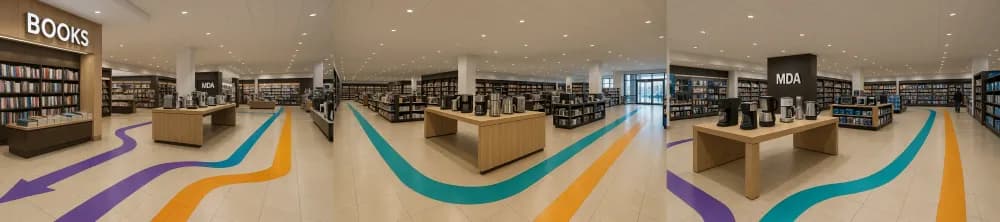
Loop, racetrack, free-flow, and grid: the four shopper flow patterns explained, with retailer examples and a worked store walkthrough.
BlogJun 5, 2023Shopping Malls
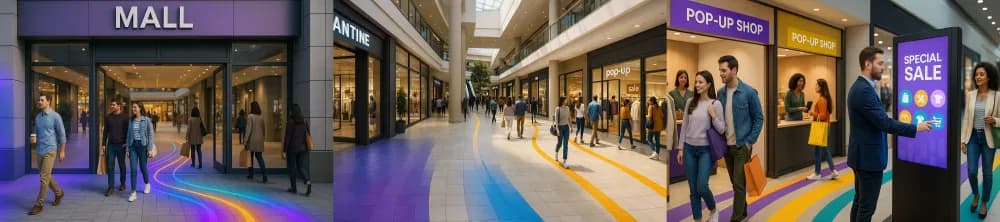
How shopping malls stay competitive: pop-up store rotation, tenant mix data, real-time visitor analytics, and engagement features that drive return visits.

BlogJun 2, 2023Retail Stores
How to read a store heatmap in six steps. Real 2026 examples, the patterns that signal a layout change, and how heatmaps work without cameras.

BlogJun 2, 2023Retail Stores
Why retail staff still beat e-commerce: in-store assistance, data-led scheduling, and conversion data sales associates can act on.

BlogJun 1, 2023Airports
How airports offset traffic decline with non-aeronautical revenue: dynamic lease pricing, anchor tenant strategy, smart queueing, and retail mix data.

BlogMay 30, 2023Shopping Malls
Anchor tenants are the large retailers that drive footfall to a mall. Definition, types, lease economics, and what is replacing department stores in Europe.

BlogMay 30, 2023Retail Stores
Eight data-driven steps to redesign a retail store: customer flow, dead-zone removal, sensory layers, and layout-to-sales correlation. With concrete examples.

BlogMay 29, 2023Retail Stores
What e-commerce and physical retail each genuinely win on, why the real gap is measurement, and the five plays stores use to compete with online retailers.